
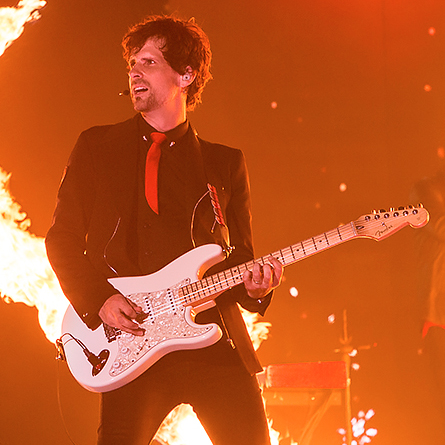
 Cory Churko
Band – Guitarist
Cory Churko has enjoyed a multi-faceted career in the music industry for over 30 years. His talents as an award winning multi-instrumentalist, vocalist, mix engineer, and digital editor are the reason why he is one of the most sought after and valued people in the entertainment industry. He has worked with legendary artists such as Shania Twain, Kelly Clarkson, Reba McEntire and Mutt Lange.
1. Who are you on tour with right now and what do you do for them?
Right now I’m in between tours. I just got off a 2015 North American tour with Shania Twain. I play guitar, fiddle, vocals and keyboards for her and I am the band leader.
2. Wow, that’s incredible. She’s a legend! What do you do when you’re not on tour with Shania?
When I’m not on the road you can find me in my studio producing, mixing, doing sessions, and writing. If I’m not working I’m usually out hiking ha ha!
3. Gotta keep those chops up, and still make time to enjoy a little nature too. What do you like most about working with Kelly Clarkson and Shania?
I like that their music is great and that they’re very down to earth people. I wouldn’t last very long with an ego maniac. It takes a team of talented people to make any project successful and both Kelly and Shania know this and are very grateful for the people they work with. This makes everyone feel appreciated. They also allow the musicians to be a bigger part of the live show than other solo artists who make their bands wear black and stand in the back. That makes things more exciting for us.
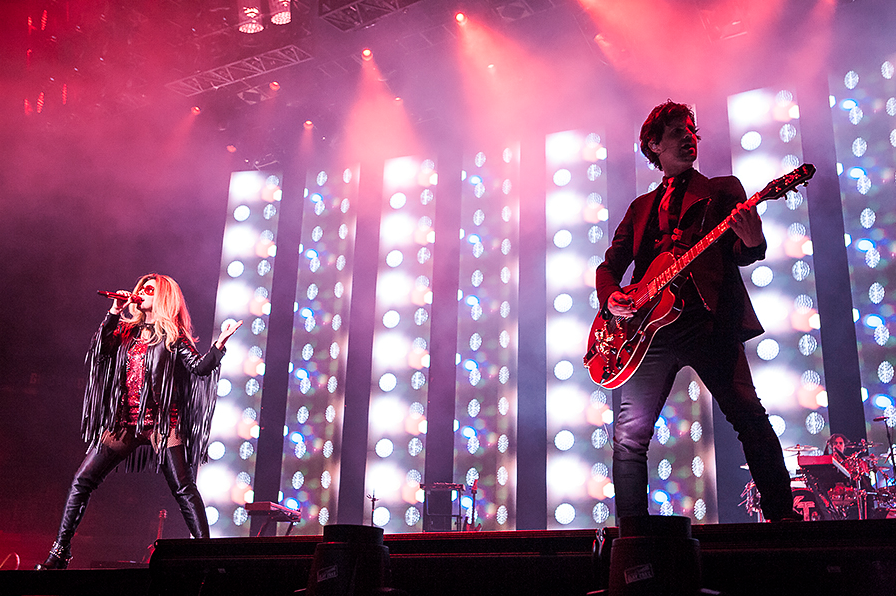
4. I noticed that too when I worked with you on Kelly’s 2006 tour, she did share the spotlight, which is rare and awesome. You certainly deserve to be in the spotlight, you play so many instruments. Can you name all of them, and what is your favorite and why?
Well I’m kind of a hack of all trades. My main instrument is guitar but I was hired by both Shania and Kelly originally as a fiddle player. My first instrument was piano and played classically as a kid. That was a great foundation for my music. Because I play fiddle and guitar it’s easy to apply that to mandolin as it’s tuned like a fiddle but approached more like a guitar. I can play a limited amount of Irish whistle too 
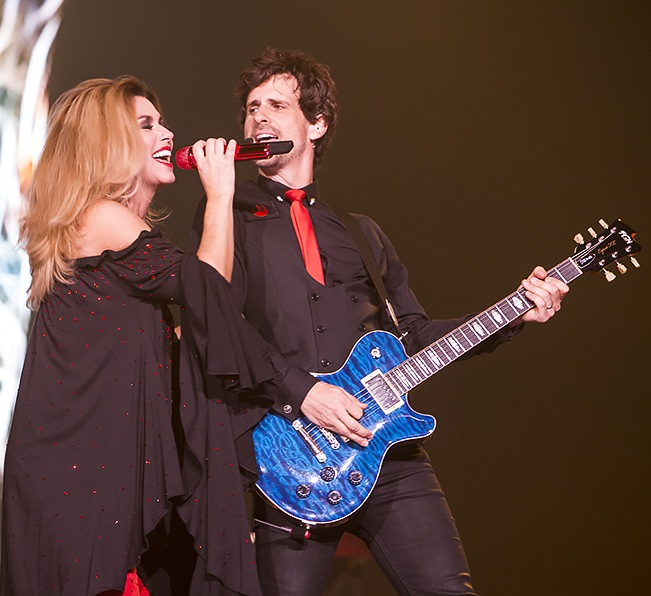 5. Nice! You are no hack, you use to blow my mind with your shredding jams before sound check. Can you describe what gear you use with Kelly Clarkson and Shania, and why you chose it?
Well, I like to think outside the box and try different things live. In the past I put all my instruments and vocals through a Pro Tools system and ran SMPTE timecode to it. I would automate everything through that. The Pro Tools session would run in real time, locked with the show computer. My vocal mic would turn on when I was singing and turn off when I wasn’t. That would keep things clean in my ear mix with limited bleed. All my guitar patch changes, wah pedal sweeps, special fx, and live fx would be programmed so all I had to do was concentrate on playing. If I was playing keyboards, same thing, I would use soft synths and effect them in Pro Tools.
Of course this approach only works if you play the song exactly the same every night. With Shania that’s usually the case but with Kelly we change things a lot so in the end I either just did things traditionally or I would get fed midi program changes from the show computer to change my guitar patches.
I also am not a purist when it comes to approaching the guitar. I will try anything new to see how technology can work for me. I incorporated the Line 6 Pod early on. I learned where the strengths and weaknesses were in that kind of approach. I like playing through real amps but I hate the inconsistency of tubes and speakers and the tap dance associated with turning pedals on and off. I hated how the sound changed if I had to put cabinets in an iso box. Sure it was ok and possible to deal with it, but it wasn’t as good as a cabinet in the open pushing air. This last tour with Shania and on previous Kelly gigs I fell in love with the Kemper profiling amps. I could profile my own amps and use those resulting profiles digitally. The sound was the same every night and it sounded like my amps without the fuss and inconsistency.
I also hated using rental gear on fly dates. With the digital options like the Line 6 or Kemper I didn’t have to worry about not having the sounds I needed.
On the last tour with Shania there wasn’t a live amp on stage. Everything was a Kemper or Sans Amp.
My rig consisted of:
Guitar, fiddle, acoustic guitar > wireless (splits) >RJM rack gizmo (8 loops) > Kemper (fx loop > Line 6 HD 500)> Front of House (mono)
> Fishman Aura for acoustic guitar
> Fishaman Aura for fiddle
> Line 6 Pod HD Pro > Front of House L/R
6. I remember that rig well, as I helped put it together. I thought it was so innovative of you to use automation as a guitar player, and your sound was perfect every day. Do you use any gear that most people wouldn’t know about, why you like it?
Well what I do as a guitarist with my setup is quite unique I think. Instead of sending a stereo signal to front of house, I send 3 outputs. The first output is the mono Kemper with minimal fx and the second and third outputs are the fx from the Line 6 Pod HD Pro. My guitar signal splits right out of the wireless. One of those splits goes to the RJM Rack Gizmo and the other signal goes to the Pod Pro, which only has a wet fx L and R output. This allows the front of house mixer to pan my mono signal wherever he wants while panning the fx of the Pod pro hard left and right. The result is my guitar maintains a nice stereo spread even when my mono signal is panned a little to the left or right. So many times in the past I would find out that my nice stereo signal had been mono-ed because the sound tech wanted to pan the two guitarists in the band left and right. This makes total sense of course when there’s two guitarists. But whats the point of even having a stereo feed to FOH if it’s just going to be mono-ed anyway.
The other thing I am able to do with this setup is send all my acoustic instruments down these same 3 lines. Because everything is digitally based, I can turn the amp simulations off for the fiddle and acoustic guitar while still utilizing the fx on the Kemper or Pod.
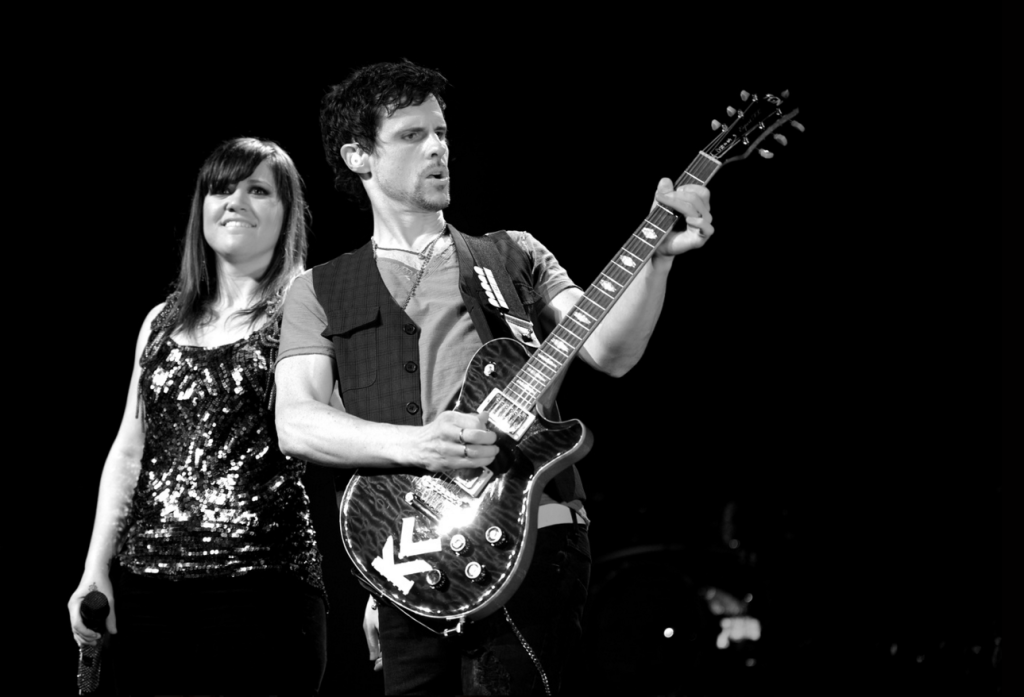
7. Very efficient. You spent some time with Mutt Lange, what was that like and what did you learn from him?
Working with Mutt was like going to school and getting paid for it ha ha. He has a very high standard and he tunes and refines the ear of anyone who works with him. He is the nicest guy but works hard and expects those around him to do the same. I can’t say enough about my time with him. Very demanding but so rewarding.
When I first started working with him the first thing I learned was that my timing was awful. He told me that I rushed everything. It’s something many guitarists suffer from. Working with Pro Tools really refined my ear to timing as well because you can see on the grid where you’re pushing. You can then slide it over and as soon as your ear hears how much better it is you become sensitive to timing and groove and overall I gained maturity from that as a musician.
I also learned a great deal about mixing as I did all the Pro Tools work on the mix of the Shania Twain Up record. We would EQ almost every syllable of the lead vocal. I have to say I don’t do this now as it’s very time consuming, but I know the value of this and utilize the same procedure on certain parts of a vocal track when I mix.
8. That is intense, what an incredible experience though. How does being a musician help you as a music producer and sound engineer?
Playing live as a musician is the foundation of who I am as a producer and sound engineer. I learned all about EQ when I would set up the sound for all the bar gigs I’ve played at. I learned where all the frequencies were when I would ring out the PA each day. My brother and I always did everything ourselves even when we shouldn’t have. We made a lot of mistakes mixing our own projects but it was an invaluable learning experience for us. Years and years of playing in cover bands also gave me a good foundation for how hit songs were made. Also, over the years playing live I’ve learned what kind of sounds are the best for certain genres of music; everything from speakers to strings, to amps, to tubes, etc. I think all these things and experiences help me in the studio.
9. Absolutely, there are so many nuances in creating great sound, you definitely figured it out. Can you describe the process of producing a record for someone else?
It’s a different approach for different artists or acts. If it’s a singer/songwriter I will do most of the tracks myself, including programming drums and bass. If the song needs real drums by the time I’m done with the track I’ll add a real drummer at the end. Color instruments that I can’t do, I’ll farm out to my friends. These would be instruments like steel guitar, dobro, etc.
If it’s a band, I’ll usually get the band rehearsed on the songs together in one room so they can all have input and there won’t be any surprises when it comes down to laying the tracks down. The whole band will track together and I’ll keep what I can, but typically everything except the drums will be overdubbed. It really does depend on the band and how raw or polished the target sound will be.
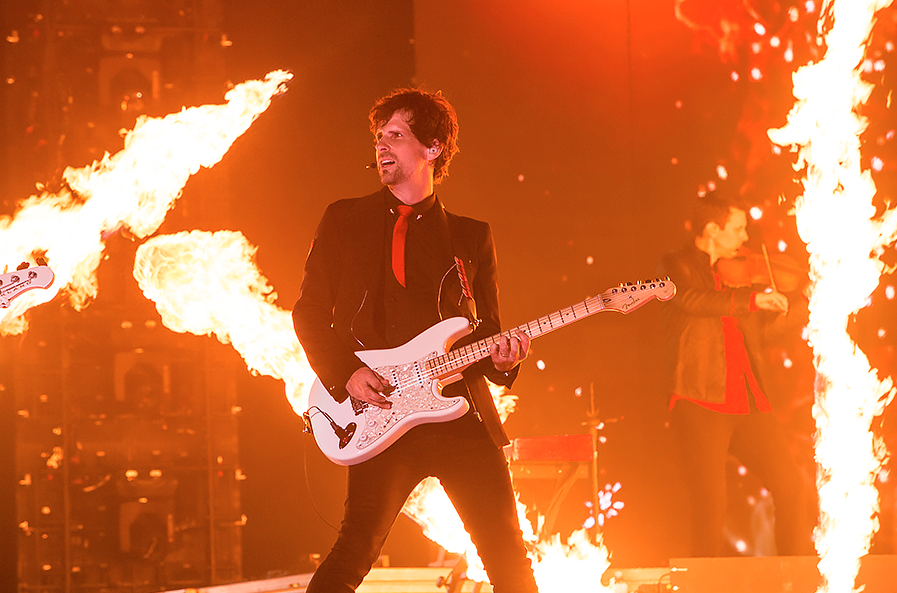
10. I love it, very similar to my approach as well. What do you do to prepare for a performance, mentally and physically?
On the Shania tour, about an hour before show time I stretch out with some yoga stuff just to loosen up. Then the wardrobe goes on and I’ll go to side stage to warm up my hands. Typically, I’ll go through some of the solos I’m about to play and then I’ll just do some scales or chromatic exercises. While I do this I’m also humming and singing to get the pipes warmed up.
That sounds like a good way to keep your body performing consistently every night. Thank you! Cory Churko, Guitarist. It has been an honor to interview you, and a pleasure to get to know you better…
Join Cory’s Social Network
By Clicking The Link Below…
www.CoryChurko.com
Photo Credits:
1) Adrien O’Brien
My Friends on Tour
Ruki Garuba
Fashion Stylist – Michael Bolton, Kelly Rowland, Keyshia Cole

Cameron Handel
Trumpeter – Michael Bolton, Seal, Blast!
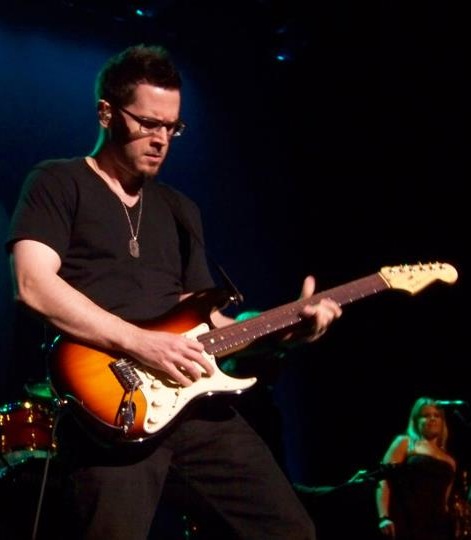
Ryan Parrino
Guitarist – Michael Bolton, Smokey Robinson, Kenny G
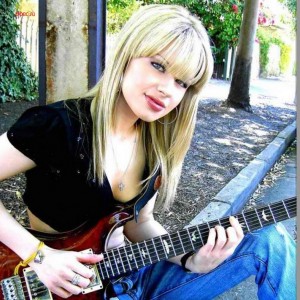
Orianthi
Guitarist – Michael Jackson, Steve Vai, Alice Cooper

Zach Rudulph
Bassist – Andy Grammer, Jewel, Gavin Degraw
Cory Churko
Guitarist – Shania Twain, Kelly Clarkson, Reba McEntire
The complete backstage experience. Go behind the scenes and get to know the band and crew. Here are their candid perspectives.
 Ryan Huddleston
Bass Tech, Programmer
 Rob Greene
Monitors Sound Engineer
 Jason Moore
Front of House Sound Engineer
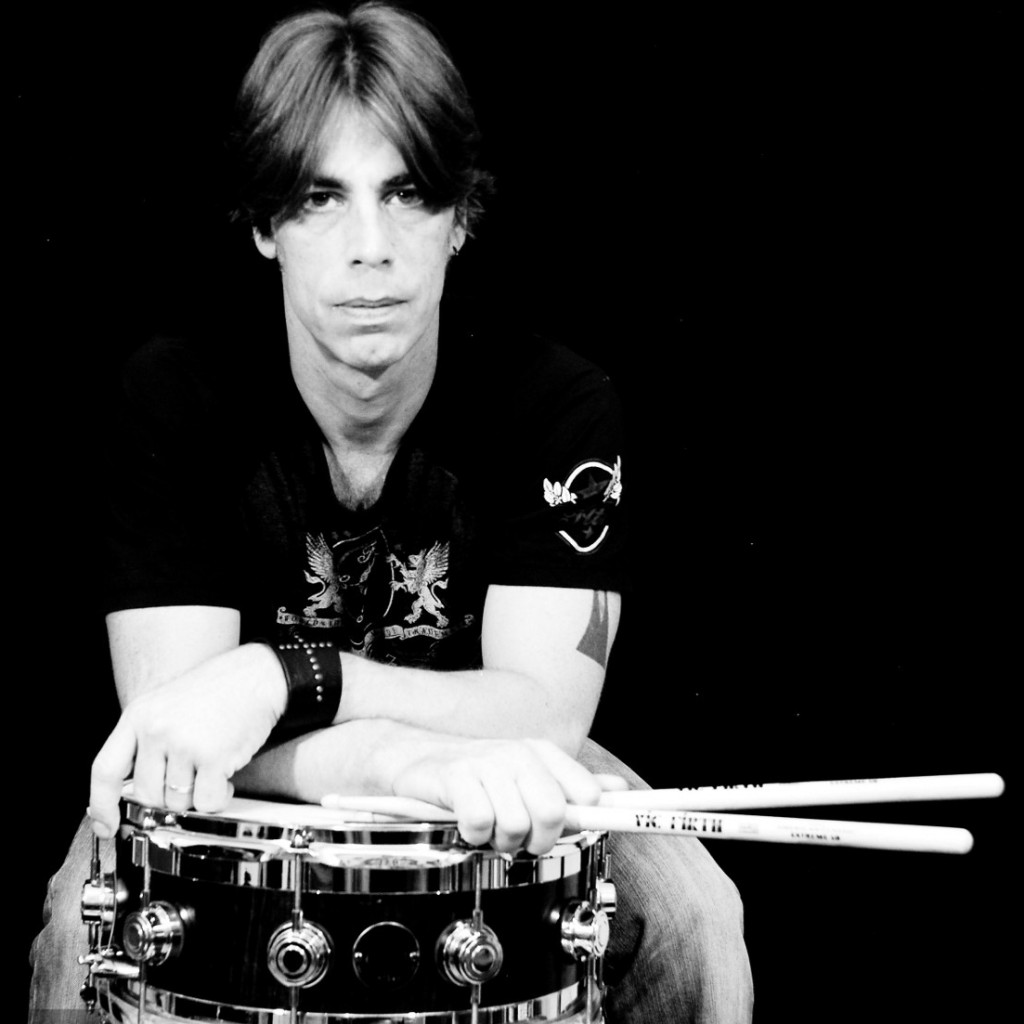 Kenny Sharretts
Drum Tech
 Brock Hogan
Lighting Designer
 Ian Planet
Guitar and Keyboard Tech
Moose Douglass
Guitar Tech
 Pergo
Pergo
Pat’s Assistant


Elixir strings troubleshooting videos with Ryan Huddleston Ryan’s Recent Projects
Teknix Concepts Switchers Guitar Workshops Greatest Guitar Solos of All Time Music Videos by Music & Videos by Ryan Tricknology Video Series 8-DVD Set Tone Teknix Audio Teknix Impentris Approaching the Darkness Guitar Serenity The Eras and Beyond International Roadie Music & Audio Tools Test Signals for Audio Systems
Teknix Resource Library Tips & Trix Shred Lix & Trix My Friends on Tour Equipment Endorsements International Roadie Memiors Follow Ryan Huddleston around the globe to the coolest places on the planet